
Engineering | Notes · Strategy · Shipping Notes
Why Business Clarity Matters More Than SEO Alone
SEO can drive visibility, but without business clarity, trust, and operational readiness, traffic alone will not convert.
A lot of business owners assume that once a website is live, sales and conversions will naturally follow. It sounds reasonable on the surface. After all, if people can find your business online, results should come, right?
But not quite.
A website is not a magic switch. SEO is not a rescue plan for an unclear business. Visibility can help, but visibility alone does not create trust, clarity, or operational readiness. It only exposes what is already there.
This is something I have seen repeatedly when working with clients. Some want a website, but have no clear brand direction, no structured messaging, no documented service details, and no time set aside to answer the questions that would help shape the project properly. Yet, they still expect the final product to somehow generate results on its own.
That expectation is usually where the real problem begins.
When clients provide little context, developers are often forced to fill in the blanks. We make the best decisions we can with the information available, but there is a limit to what good engineering can solve. A developer can build a solid website. A developer cannot invent business clarity where none exists.
This came back to me after I raised a similar concern during a conversation in a X/Twitter space. I was talking about how some business owners expect immediate commercial results simply because their website has gone live. The discussion shifted quickly. Some people asked whether I offered SEO. Others suggested adding things like company profiles or brand guides as part of the service.
Those are useful suggestions, but they do not fully address the root issue. A company profile still takes time to prepare. A brand guide still requires thought and direction. SEO still needs something strong enough to amplify.
So the question became clearer in my mind: can SEO guarantee sales or conversions?
No, it cannot.
The Foundation Has Two Sides
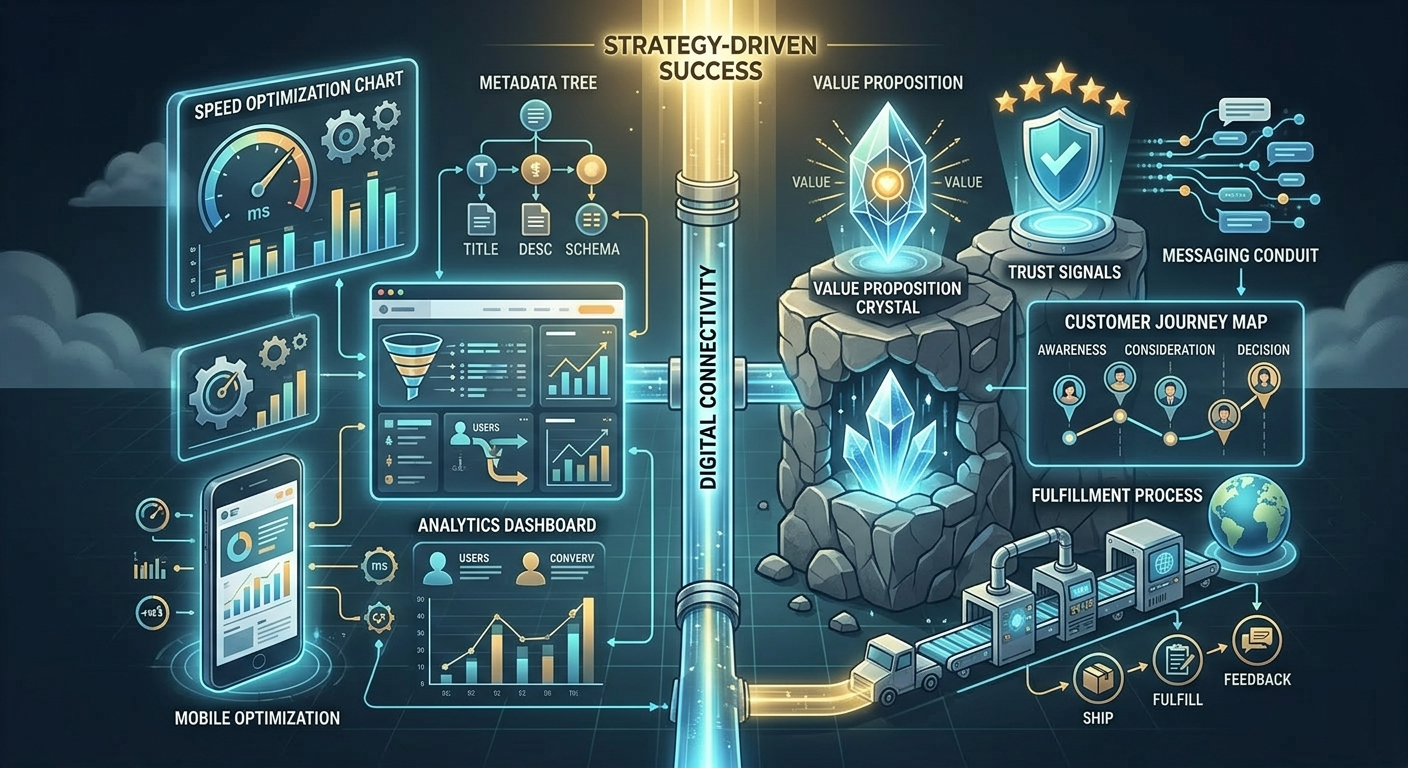
For SEO, or any digital strategy, to produce meaningful results, two different foundations need to exist at the same time: the technical foundation and the business foundation.
What the developer can build
A developer can create the technical conditions for a website to perform well:
- Fast load times and a good mobile experience.
- Clear navigation and usable page structure.
- Clean code and technical SEO basics such as metadata, schema, sitemaps, and crawlable pages.
- Analytics and tracking setup.
- Secure browsing with HTTPS and responsible data handling.
- A proper content structure for blog posts, product pages, service pages, landing pages, and search visibility.
All of this matters. A slow, confusing, poorly structured website will struggle no matter how good the marketing is. Technical quality gives the site a fighting chance.
But that is only one side of the equation.
What the business owner must bring
The business itself has to be ready for discovery.
That means having:
- A clear value proposition.
- A defined target audience.
- Service or product information that actually answers customer questions.
- Trust signals such as testimonials, policies, reviews, guarantees, or proof of work.
- Consistent messaging and brand presentation.
- A working process for responding to leads, inquiries, or purchases.
- The operational capacity to deliver what the website promises.
If those things are missing, SEO does not fix the problem. It simply makes more people notice it.
Visibility Does Not Solve Weak Positioning
This is the part many people miss.
SEO can bring traffic. It can improve discoverability. It can help the right people find your business when they search for a solution.
But traffic is not the same as conversion.
A business might rank on Google and still struggle to get results. Imagine someone lands on a service page and finds vague copy, no pricing guidance, no clear offer, no testimonials, and no obvious next step. Maybe the contact form works. Maybe the page loads fast. Maybe the metadata is perfect.
That still does not mean the visitor will trust the business enough to take action.
The issue in that case is not discoverability. The issue is that the business is not positioned clearly enough to convert the attention it receives.
SEO can amplify visibility. It cannot manufacture trust or sharpen a weak offer.
Development and Marketing Are Not the Same Job
Another source of confusion is that people often collapse development and marketing into one responsibility.
They are connected, but they are not the same thing.
A developer can build the website, structure the content system, optimize the experience, implement analytics, and prepare the platform for growth. In some cases, the developer may even help set up the technical framework for search visibility and content publishing.
But that does not mean the developer is also responsible for ongoing content strategy, ad campaigns, search targeting, social media positioning, lead generation, or brand communication.
Those functions belong to marketing, content, and business strategy.
The simplest way to frame it is this:
A developer prepares the website to perform when people arrive. A marketer helps bring the right people there. The business owner must make sure there is something credible and compelling waiting for them.
If any one of those three pieces is weak, results will suffer.
Why This Distinction Matters
This matters because it protects both expectations and execution.
When business owners assume a website alone will produce results, they place unrealistic pressure on the build itself. When developers accept responsibility for outcomes that depend on business clarity and marketing follow-through, frustration becomes almost inevitable.
A well-built website is important. Good SEO is important. Strong performance, clean structure, and clear UX are important.
But none of them can carry a business that is unclear about what it offers, who it serves, or how it converts attention into action.
The truth is simple: a website is an asset, not a miracle. SEO is leverage, not salvation.
Conclusion
Before asking whether SEO is enough, a business should ask a more important question: are we ready to be found?
If the answer is no, then more visibility will not solve the core problem. It will only expose it faster.
The technical side matters. The business side matters. Marketing matters. When those parts work together, a website becomes a serious growth tool.
When they do not, expecting SEO alone to drive conversions is like shining a spotlight on an empty stage.